Brake Fluid, Decoded: DOT 3, DOT 4, DOT 5.1 and DOT 5
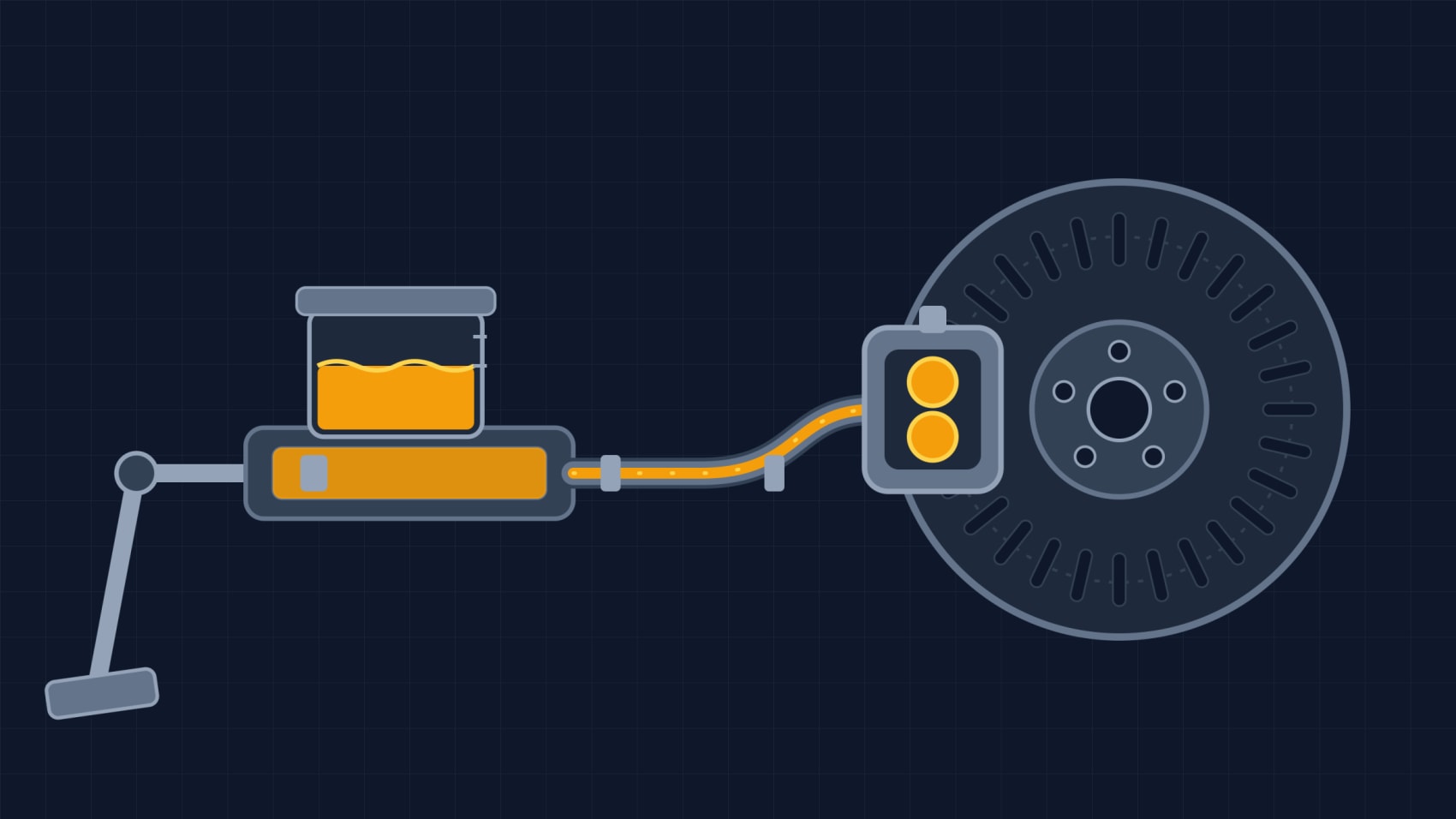
Your brake pedal is a small miracle of translation. You press it with one foot, and a few moments later a two-ton vehicle that was doing 65 miles an hour changes its mind. The thing doing the translating is a thin amber liquid that lives in sealed tubing, gets squeezed thousands of times a day, and goes ignored by most drivers until the pedal starts feeling strange.
That liquid is brake fluid, and it deserves more respect than it gets. This guide covers what it does, how the DOT types differ, when to change it and which of the 21 brake fluids at Sauto Mobils fits which job.
The one fluid that gets paid to be squeezed
Brake fluid works for a simple reason: liquids don’t compress. When you press the pedal, the pressure travels through the lines to each caliper, and the car slows down. If something compressible sneaks into that fluid, the system stops behaving like a solid rod. As one parts guide puts it, vapor can be squeezed while fluid cannot, so the pedal feels spongy and may go all the way to the floor with little stopping power. fridayparts
Brake fluid also has a drinking problem. DOT 3 and DOT 4 are glycol-based, and they’re hygroscopic, meaning they absorb water. That’s partly by design, since the fluid soaks up moisture instead of letting it pool and rust things from the inside. The catch is that absorbed water lowers the fluid’s boiling point, and brakes make a lot of heat. Fluid that boils under hard braking becomes vapor, and vapor is exactly the compressible problem described above. slashgear
DOT 3, DOT 4, DOT 5.1 and DOT 5: who’s who
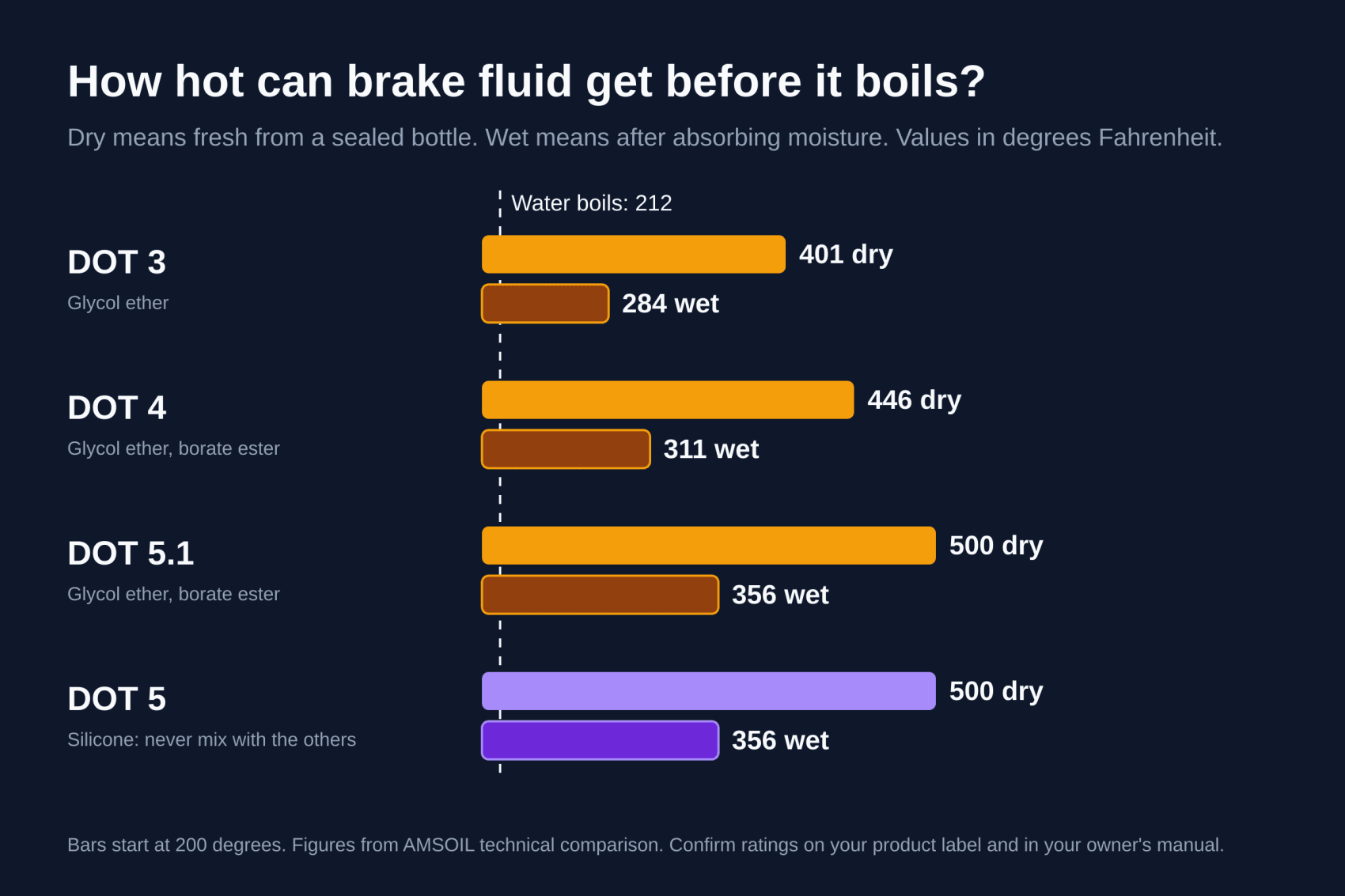
The Department of Transportation classifies brake fluid into four numbered types. Two numbers matter for each: the dry boiling point (fresh fluid from a sealed bottle) and the wet boiling point (fluid that has absorbed some moisture). Here are the figures from AMSOIL’s technical comparison:
DOT 3: about 401°F dry and 284°F wet, glycol ether based. It’s the long-time default for many vehicles.
DOT 4: about 446°F dry and 311°F wet, with a glycol ether and borate ester composition. It’s the step up, and it’s mostly used in European cars but is becoming more common worldwide.
DOT 5.1: about 500°F dry and 356°F wet, also glycol ether and borate ester. It’s the high-temperature glycol option for performance and heavy-duty use.
DOT 5: the same 500°F and 356°F figures, but silicone-based. It’s an entirely different chemistry. amsoil
The mixing rules (the part worth memorizing)
DOT 3, DOT 4 and DOT 5.1 are all glycol-based and compatible. A shop might blend them in a pinch, but mixing lowers the boiling point of the whole batch to that of the weakest fluid, so a proper flush is better. One guide notes that DOT 5.1 is generally safe in vehicles that call for DOT 3 or DOT 4, though it’s best to have the system bled before switching fluid types.
DOT 5 never mixes with the others. Since DOT 5 is silicone-based, it should never be combined with glycol-based DOT 3 and DOT 4. It’s usually purple, which helps tell it apart from the amber of DOT 3 and DOT 4.
DOT 5 isn’t a “better 5.1.” Despite the similar names, upgrading from DOT 3 or DOT 4 to DOT 5.1 is fine, but never to DOT 5. Some experts also say silicone isn’t suited to road cars with ABS, since it doesn’t lubricate ABS pumps. Use DOT 5 only if your manufacturer specifies it.
What brake fluid does my car take?
Skip the guessing and check two places: the reservoir cap, which usually prints the DOT rating, and your owner’s manual. A few extra notes:
Many Ford, Lincoln and Mercury vehicles call for a low-viscosity DOT 4 LV fluid. Always confirm against your manual.
European cars commonly specify DOT 4.
Motorcycles, classics and specialty builds sometimes call for DOT 5. Verify before you buy.
How often should you change brake fluid?
Most guidance lands in the same place. J.D. Power says generally every two years or 20,000 miles, and SlashGear recommends flushing at least every two years. Brake & Front End adds that although most owner’s manuals don’t list a firm interval, a change every two years is a good preventive step to minimize the danger of fluid boil and internal corrosion. Your manual, your climate and how hard you brake can all move that number.
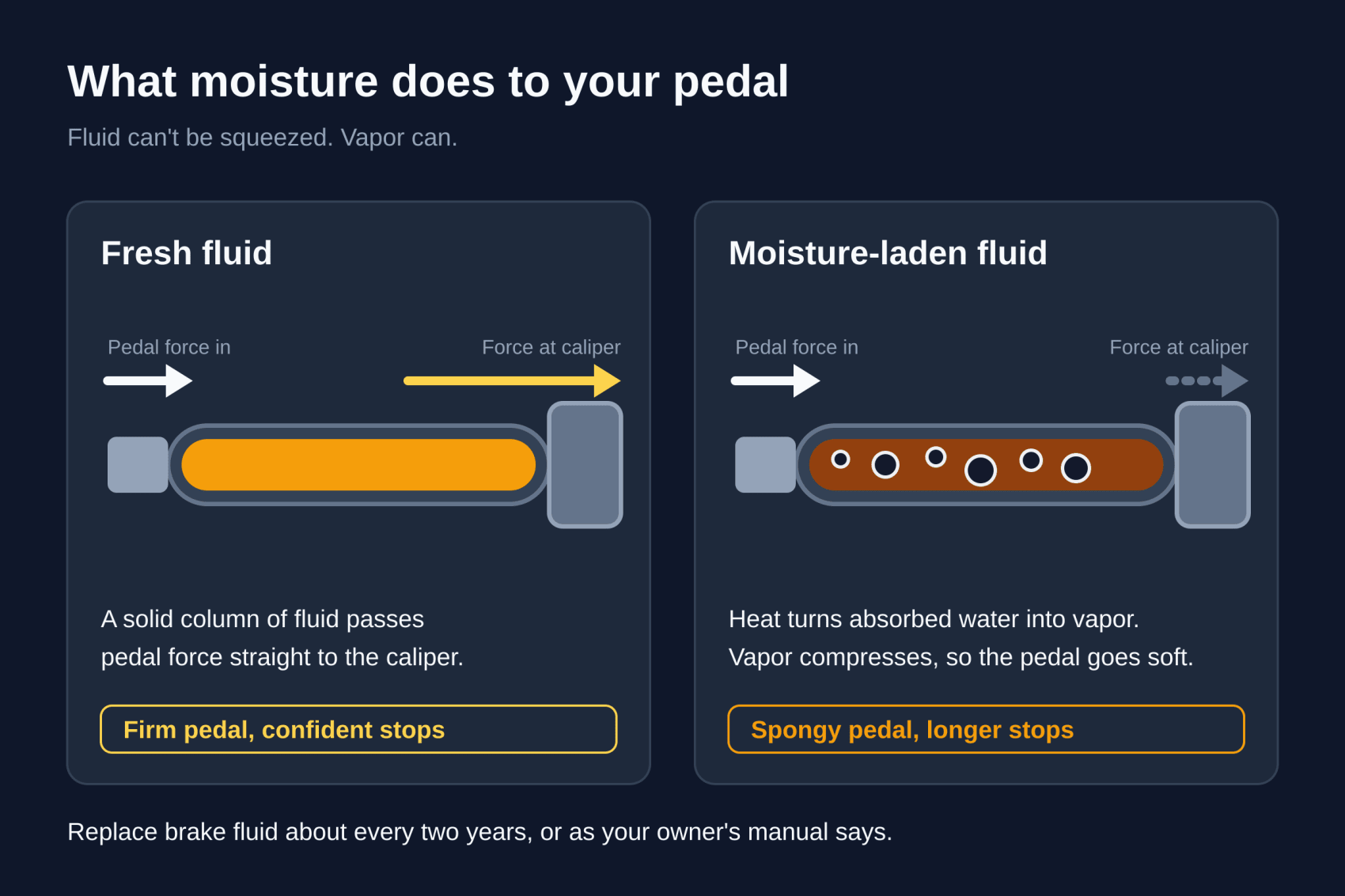
The first warning sign tends to be pedal feel. A soft, spongy pedal, or one that sinks too far before the brakes respond, often means air or moisture in the lines. Other flags include longer stopping distances and fluid that looks dark or cloudy in the reservoir.
One more point: topping off the reservoir doesn’t replace old fluid in the lines and calipers. A proper brake fluid flush pushes fresh fluid through each wheel, farthest from the master cylinder first, while keeping the reservoir full. If you’re not comfortable doing it, a shop can do it quickly. Fluid is also hard on paint, so wipe up spills right away and dispose of old fluid responsibly.
The Sauto Mobils shelf: 21 brake fluids, sorted by job
Here’s how the brake fluid category lines up. Prices are as listed at the time of writing, and you can filter the full catalog from the brake fluid category or the product catalog.
DOT 3: the everyday workhorse
If your cap says DOT 3, you have eight choices, from a can in the glovebox to a jug for the workshop shelf:
Small cans for top-offs: Prestone 12 oz DOT 3 at $3.00 and Motorcraft 12 oz DOT 3 at $7.50 for Ford owners who like matching the factory badge.
The 32-ounce sweet spot: Pure Guard 32 oz DOT 3 at $4.25, Prestone 32 oz DOT 3 at $5.00 and Wagner 32 oz DOT 3 at $6.50. A full flush often needs more than a small can, so this size tends to be the practical starting point.
A quart with a loyal following: Lucas Oil 1 quart DOT 3 at $6.25.
Gallons for shops: Pure Guard 1 gallon DOT 3 at $14.99 and Prestone 1 gallon DOT 3 at $15.99. Do the math: the Prestone gallon works out to roughly 12.5 cents an ounce, while the 12-ounce can runs 25 cents an ounce.
DOT 4: the step up
DOT 4 is the better fit if your manual says so, and the shelf has eight options:
Small cans: BrakeBest 12 oz DOT 4 at $3.50 and Prestone 12 oz DOT 4 at $4.00.
Quart-size service: BrakeBest 1 quart DOT 4 at $6.25 and Prestone 32 oz DOT 4 at $6.50.
European-car favorite: Pentosin 1 liter DOT 4 at $10.49, with a second 1-liter listing at $12.99, and the Pentosin 5 liter DOT 4 at $33.49, which comes to about $6.70 a liter versus $10.49 for the single liter.
Ford-specific: Motorcraft 16 oz DOT 4 LV at $13.49. The listing identifies it as an ether-based DOT 4 LV fluid recommended by Ford for Ford, Lincoln and Mercury vehicles.
The multi-spec options
Two bottles are labeled for more than one rating, which makes them convenient for shops that service mixed vehicles. Check the label for the exact standards:
Valvoline 32 oz DOT 3 / DOT 4 at $7.00
Bosch 32 oz DOT 3 / DOT 4 / DOT 5.1 at $9.99
DOT 5.1: more headroom
For heavy braking, towing or performance builds that call for it, there’s Prestone DOT 5.1 at $8.49. It’s glycol-based, so it’s compatible with DOT 3 and DOT 4 systems, but check your manual first.
DOT 5 silicone: for the specialists only
The two silicone fluids are Motor Medic 11 oz DOT 5 at $8.00 and Motor Medic 1 quart DOT 5 at $16.50. Use them only in systems that were built or converted for silicone, and never top off a glycol system with them.
Buying brake fluid for a shop or fleet
Sauto Mobils is set up with wholesale buyers in mind, and the rules are written down:
A $500 minimum cart for low-priced items. You can mix products to reach it, so brake fluid pairs naturally with motor oil, transmission fluid and antifreeze in one order. The payment and ordering page has the details.
Volume tiers on the listing. On the Motorcraft DOT 4 LV, for example, 38 units meets the minimum, with 5% off at 57, 10% off at 76 and 15% off at 114. Tiers vary by listing, and the bulk pricing page explains the program.
Shipping and returns spelled out. See the shipping and delivery page and the returns and warranty page. The returns policy lists hazardous materials among non-returnable items, so confirm how it applies to brake fluid before you order.
A real local address. The team is based in Little Rock, Arkansas, so if you’re searching for brake fluid near me in the area, ask about local pickup.
What customers say
“Sauto Mobils has been my go-to supplier for over 5 years. Their product quality and customer service are unmatched.” — John Smith, Professional Mechanic, New York, NY
“Their payment and ordering information page is incredibly transparent. I always know exactly what to expect with minimum orders and bulk pricing.” — David Wilson, Auto Shop Owner, Seattle, WA
“As someone who works on my own cars, I need reliable parts. Sauto Mobils never disappoints.” — Emily Rodriguez, DIY Mechanic, Miami, FL
Quick answers
Can you mix DOT 3 and DOT 4 brake fluid?
Both are glycol-based and generally compatible, but mixing isn’t ideal because it dilutes the higher-rated fluid. A full flush is the cleaner approach.
Can I use DOT 4 in a system that calls for DOT 3?
Usually yes, since it’s the same glycol family with a higher boiling point, but follow your manual.
Can I use DOT 5.1 instead of DOT 4?
In most cases, yes, since it’s compatible with DOT 3 and DOT 4. Never substitute DOT 5.
What’s the difference between DOT 5 and DOT 5.1?
DOT 5 is silicone-based and can’t be mixed with the others. DOT 5.1 is glycol-based and mixes with DOT 3 and DOT 4.
What color is brake fluid?
Fresh DOT 3 and DOT 4 are typically amber, and DOT 5 is usually purple. Glycol fluids darken as they age.
How often should I change brake fluid?
Commonly every two years, or sooner with heavy braking, towing or humid climates. Check your manual.
What are the signs of bad brake fluid?
A spongy or sinking pedal, longer stopping distances and dark or cloudy fluid in the reservoir.
The bottom line
Brake fluid is cheap insurance for the most important system in your car. Read the cap, match the DOT rating, keep it fresh and never mix silicone with glycol. When you’re ready to compare options, start with the Sauto Mobils brake fluid category or the full product catalog.
Sources