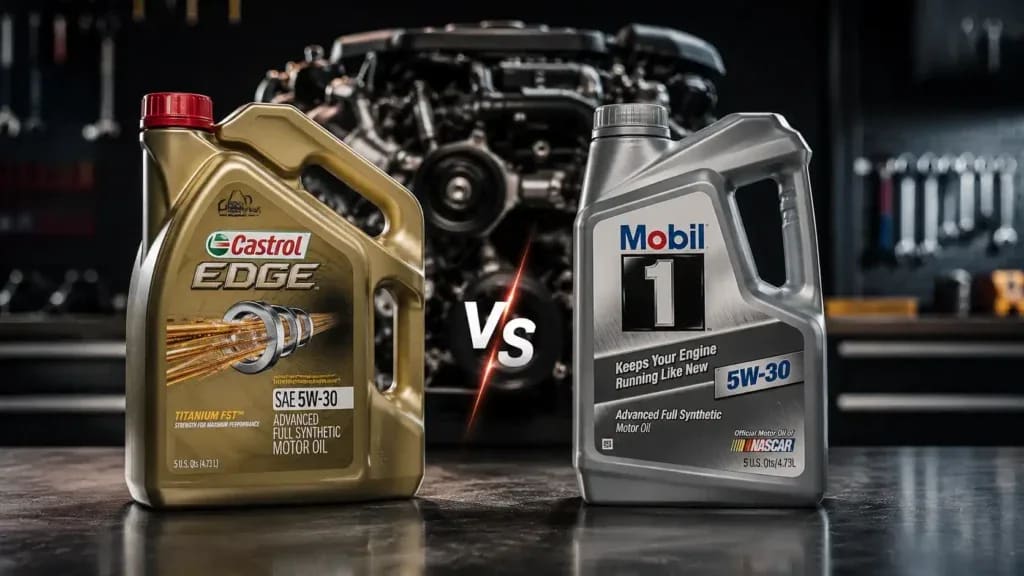
Castrol vs Mobil 1: 5W-40, 0W-20 & 0W-16 Compared
Picture two gleaming jugs on a shelf. One has a red label and a reputation for engines that run hot and hard. The other wears a bold blue-and-red badge and has been a household name in full synthetics for decades. You’re holding a manual that says 0W-20, or 5W-40, or something unfamiliar like 0W-16. Which jug do you grab?
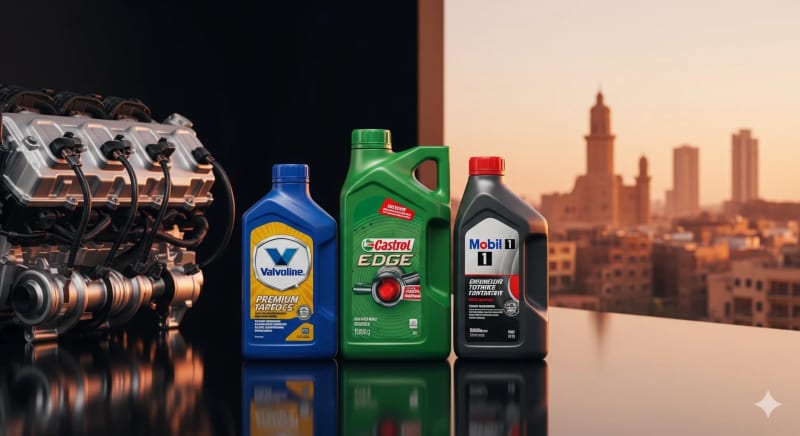
Welcome to the thin-oil showdown. This guide puts Castrol and Mobil 1 side by side across the grades drivers search for most: Castrol 5W-40, Castrol Edge 5W-40, Castrol 0W-20, Mobil 1 0W-20 and Mobil 1 0W-16. No hype and no declared champion. Just the facts you need to match the right oil to the right engine, plus where to buy it at wholesale prices from Sauto Mobils.
The best oil in the world is the one your owner’s manual already named.
Meet the contenders
Castrol Edge 5W-40. The European-spec heavyweight, sold in the U.S. as Castrol EDGE Euro Car 5W-40 A3/B4.
Castrol Edge 0W-20. Castrol’s thin synthetic for modern gasoline engines and hybrids.
Mobil 1 0W-20. The mainstream thin synthetic from Mobil, available in several formulas.
Mobil 1 0W-16. The ultra-thin specialist for select Honda and Toyota engines.
Round one: decoding the numbers
Every grade has two numbers. The first, with a W for winter, shows how freely the oil flows when cold. Lower means faster flow on a cold start. The second shows thickness at operating temperature.
0W-16 is the thinnest hot. Least drag, most efficiency, narrowest fit.
0W-20 is the modern all-rounder. Thin hot, with a very wide fit.
5W-40 is the stout one. It holds a thicker film at operating temperature, which suits engines that run hot or hard.
Thin isn’t better and thick isn’t better. Right is better, and right means whatever your manual specifies.
Round two: the European specialist, Castrol Edge 5W-40
If a thin oil is a sprinter, 5W-40 is a long-distance runner with a backpack full of approvals. Sauto Mobils lists this oil as Castrol EDGE Euro 5W-40 A3/B4, built for European cars.
Published product information says that it meets API CF/SP and ACEA A3/B4, and carries BMW Longlife-01, Mercedes-Benz MB-Approval 229.5, Porsche A40 and VW 502 00/505 00 approvals. Retail listings add that it also meets Chrysler MS 12991 engine test requirements and Renault RN0700/RN0710. You can verify the full list on Castrol’s Edge product page. petroleumservicecompanylowes
Who tends to reach for it:
Owners of BMW, Mercedes-Benz, Volkswagen, Audi and Porsche models whose manuals call for these specs
Drivers of turbocharged, direct-injection and other hot-running engines
Anyone who tows, hauls or lives in serious heat
One caution: A3/B4 is not a low-ash “low-SAPS” spec. Many particulate-filter diesels and some gasoline engines need an oil labeled ACEA C3 or a manufacturer code such as VW 504 00/507 00. If your manual asks for one of those, match it exactly.
On the shelf, you can pick up the 1-quart bottle for top-offs at $6.00, the 1-liter bottle that European owners know well at $7.00, or the 5-quart jug that covers most full oil changes at $17.48, roughly $3.50 a quart.
Is there a Mobil counterpart? Mobil doesn’t list a 5W-40 passenger-car grade on this shelf, but its European formula comes in a 0W-40. Mobil’s product guide describes its 0W-40 as built for many European vehicles, with API SP, SN Plus, SN, ACEA A3/B4, MB 229.3/229.5, BMW LL-01, VW 502 00/505 00 and Porsche A40. If your manual allows a 0W-40, take a look at the Mobil 1 European Car Formula 0W-40 quart or its 5-quart jug, both listed at Sauto Mobils. Confirm the exact approvals on the label before you pour. mobil
Round three: the 0W-20 face-off
This is the matchup most drivers care about, since 0W-20 is the factory fill for a huge share of modern vehicles.
In the red corner: Castrol Edge 0W-20
The current U.S. Castrol EDGE 0W-20 meets API SP and ILSAC GF-6, carries GM dexos1 Gen 3 approval, and meets applicable Ford and Chrysler requirements for vehicles specifying a compatible 0W-20. Castrol lists it as suitable for use in hybrids. petroleumservicecompanynapaonline
The 1-quart bottle for a quick top-off is $6.00, with a second 1-quart listing at $6.25.
The 5-quart jug for a full change is $17.98, with a second 5-quart listing at $17.48.
In the blue corner: Mobil 1 0W-20
Mobil 1 Advanced Fuel Economy 0W-20 is a licensed GM dexos1 Gen 3 oil, is recommended for applications requiring Ford WSS-M2C947-A and WSS-M2C947-B1, and meets API SP, ILSAC GF-6A, Chrysler MS-6395 and Ford WSS-M2C962-A1. Mobil also notes that it recommends its 0W-20 Advanced Fuel Economy for both 0W-20 and 5W-20 applications. Check Mobil’s official 0W-20 page for the latest labeling, since newer bottles may show updated API SQ and ILSAC GF-7A marks.
Mobil’s range is wider, so you can pick a formula for your situation:
The everyday workhorse: Advanced Fuel Economy in a 1-quart bottle at $6.00, or the 5-quart jug at $17.98
Built for longer drain intervals: Extended Performance, 1 quart at $6.50, and 5 quart at $18.98
For engines with a few miles on them: High Mileage, 1 quart at $6.25 and 5 quart at $18.48
Both approaches in one jug: Extended Performance High Mileage, 1 quart at $6.75 and 5 quart at $19.48
When the engine does heavy lifting: Truck & SUV, 1 quart at $6.25 and 5 quart at $18.48
For emissions-sensitive applications only: Mobil 1 ESP 0W-20, 1 quart at $7.00
What the 0W-20 matchup really shows
Specs overlap heavily. Both are full synthetics that meet current API and ILSAC standards, carry dexos1 Gen 3 and meet Ford and Chrysler requirements.
Prices are neck and neck. Standard 5-quart jugs are $17.98 for both, with a Castrol listing at $17.48.
Mobil offers more formula variety at Sauto Mobils, with extended-drain, high mileage and Truck & SUV versions.
Castrol’s strength is the pairing of a thin 0W-20 with its European-spec 5W-40 inside the same Edge family.
Round four: the ultra-thin specialist, Mobil 1 0W-16
Here’s where the two brands part ways on this shelf. Castrol doesn’t list a 0W-16 at Sauto Mobils. Mobil does, and it’s very specific about who it’s for.
Mobil describes its 0W-16 as engineered for select Honda and Toyota gasoline and hybrid engines where this viscosity is recommended, meeting API SP and ILSAC GF-6B. There’s one critical detail. GF-6B, unlike GF-6A, is not backward compatible with earlier ILSAC categories, so a 0W-16 should only be used when the owner’s manual recommends it. See Mobil’s official 0W-16 page for current labeling.
You can find it in a 1-quart bottle sold in cases of 6 or 12 at $6.00, or a 5-quart jug at $17.98. For another 0W-16 to compare, Valvoline offers SynPower 0W-16 in a 1-quart bottle at $5.75 and a 5-quart jug at $18.50. And for the newest engines that call for something thinner still, there’s Mobil 1 0W-8 in a quart at $6.00 or 5-quart jug at $17.98.
Cross-grade matchups drivers always ask about
0W-20 vs 5W-40
They are built for completely different engines. 0W-20 is a thin, efficiency-focused oil for modern designs with tight tolerances and variable valve timing. 5W-40 is a thicker, heat-resistant oil for engines designed around it, often European and often turbocharged. Putting 5W-40 in a 0W-20 engine can raise oil pressure and cut efficiency. Putting 0W-20 in a 5W-40 engine can leave a thinner film than the engine was designed to run on. Follow the manual.
0W-16 vs 0W-20
Both flow beautifully in the cold. The 0W-16 runs thinner when hot and fits a narrow group of engines, while the 0W-20 fits a broad one. Using 0W-20 in a 0W-16 engine can reduce the efficiency the engine was built for, and using 0W-16 in a 0W-20 engine isn’t recommended. Some manufacturers allow substitutions and some don’t, so the manual rules.
Can you mix Castrol and Mobil 1?
Different brands of the same grade can physically mix, and a top-off in a pinch won’t hurt. But for a full change, stick to one oil that meets your spec.
A fair scorecard (no trophies awarded)
What Castrol brings to the table
A European-spec 5W-40 with a long list of approvals
A solid 0W-20 with dexos1 Gen 3 and Ford and Chrysler support
Slightly lower prices on some 5-quart listings
What Mobil 1 brings to the table
A very wide 0W-20 range, including extended-drain, high mileage and Truck & SUV formulas
A 0W-16 for the select engines that require it, plus a 0W-8 for the newest
A European-focused 0W-40 for owners who can use that grade
Shop smart: how ordering works at Sauto Mobils
Want to buy full synthetic oil online without overpaying? Sauto Mobils is based in Little Rock, Arkansas, and ships across the U.S. Browse the full motor oil category or the complete product catalog to compare both brands side by side.
Case packs. The 1-quart Mobil 1 0W-16 ships in boxes of 6 or 12, and the 5-quart Castrol Edge 5W-40 ships 4 jugs to a box.
Minimums. Low-priced items like motor oil carry a $500 minimum cart total, and you can mix products to reach it. The payment and ordering page has the details.
Volume pricing. On the 5-quart Edge 5W-40 listing, 29 jugs meets the minimum, with discounts of 5% at 44 jugs, 10% at 58 and 15% at 87. On the 1-quart Mobil 1 0W-16, 84 quarts meets the minimum, with 5% off at 126, 10% at 168 and 15% at 252. Businesses can read more on the bulk pricing page.
Delivery and returns. Check the shipping and delivery page and the returns and warranty page before you order.
What customers say
“Their selection of Mobil 1, Castrol, and other top-tier oils is unmatched.” — Lisa Chen, Performance Enthusiast, Austin, TX
“Great for hybrid car parts. Knowledgeable staff and fast shipping.” — Samantha Lee, Hybrid Owner, Sacramento, CA
“Bulk orders are easy and always on time. Sauto Mobils is my go-to.” — Pedro Alvarez, Delivery Fleet Manager, El Paso, TX
Frequently asked questions
Is Mobil 1 better than Castrol Edge?
It depends on the engine and the spec. Both are reputable full synthetics, and the right choice is whichever meets the grade and approvals in your manual.
What’s the difference between Castrol Edge 0W-20 and Mobil 1 0W-20?
Both meet current API and ILSAC standards, carry GM dexos1 Gen 3 and meet Ford and Chrysler requirements. Differences come down to formulation, available versions and price.
Is Castrol 5W-40 the same as Castrol Edge 5W-40?
For most shoppers, yes. The Castrol 5W-40 on this shelf is the Edge full synthetic.
Which is best for hybrids?
Whatever your manual specifies. Many hybrids call for 0W-20, and some Toyota and Honda hybrids call for 0W-16.
Which is best for European cars?
Look for the approvals your manual lists, such as VW 502 00/505 00, BMW Longlife-01, MB 229.5 or Porsche A40.
Can I use 0W-20 instead of 0W-16, or 5W-40 instead of 0W-20?
Only if your manual allows it. These grades are not interchangeable by default.
How often should I change full synthetic oil?
Follow your owner’s manual or oil life monitor. Full synthetic often goes 5,000 to 10,000 miles, and severe driving shortens it.
Our recommendations: matching the oil to the driver
We won’t crown a winner, because there isn’t one. There is only the right oil for your engine. Here’s where to look based on what you drive:
If your European car’s manual calls for a 5W-40 with A3/B4-type approvals, start with the Castrol Edge 5W-40 5-quart.
If your engine specifies 0W-20 and you want a choice of formulas, compare the Castrol Edge 0W-20 with the Mobil 1 Advanced Fuel Economy 0W-20.
If your 0W-20 engine has seen plenty of miles, look at the Mobil 1 Extended Performance High Mileage 0W-20.
If you drive a truck or SUV that calls for 0W-20, take a look at the Mobil 1 Truck & SUV 0W-20.
If your Honda or Toyota manual specifically says 0W-16, the Mobil 1 0W-16 5-quart is built for that job.
If you run a shop or fleet, explore the volume tiers on the bulk pricing page and mix grades in one order to reach the minimum.
Whatever you choose, the formula is simple: read the manual, match the spec on the label, and let the oil do its quiet, heroic work. When you’re ready, the whole shelf is waiting in the Sauto Mobils motor oil category.